

Waterfront Homes for Sale in Point Pleasant NJ: 2026 Buyer Due-Diligence Guide
Waterfront Homes for Sale in Point Pleasant NJ: 2026 Buyer Due-Diligence Guide
Buying a waterfront home in Point Pleasant, New Jersey, starts with the address—not the view. The right property can provide direct access to the Manasquan River, canals, marinas, and nearby ocean routes, but two homes a few streets apart may have very different flood zones, dock rights, bulkhead conditions, insurance needs, and maintenance costs. This 2026 guide explains the practical checks to complete before you make an offer.
Point Pleasant Borough and Point Pleasant Beach are separate municipalities. Confirm which town governs the property, because taxes, permits, utilities, floodplain administration, and beach access can differ. Start by reviewing Point Pleasant homes for sale, then evaluate each waterfront address on its own facts.
What “waterfront” can mean in Point Pleasant
A listing may describe riverfront, canal-front, lagoon-front, marina-adjacent, or water-view property. Those labels do not automatically establish navigable access or the right to keep a particular boat at the property. Before comparing prices, identify the exact waterway, water depth at different tides, bridge clearances, the route to the inlet, and any recorded restrictions.
- Direct river frontage: wider views and convenient access may come with more exposure to wakes, wind, and salt.
- Canal or lagoon frontage: calmer water may be attractive, but depth, dredging history, turning space, and bridge clearance still matter.
- Marina-adjacent homes and condos: a nearby slip may be separately owned, leased, wait-listed, or unavailable.
- Water-view homes: a view is not the same as legal water access, dock ownership, or riparian rights.
Ask for documents rather than relying on listing shorthand. A survey, deed, title review, dock or bulkhead permits, association documents, and written confirmation of slip arrangements can clarify what transfers with the property.
Check flood exposure and insurance before setting your budget
Flood risk is address-specific. Use the FEMA Map Service Center to review the current map for the parcel, but do not stop at the map label. Request any available elevation certificate, prior flood claims or loss-history information that the seller is legally required to provide, and documentation for flood-related improvements. A qualified insurance professional can then quote the actual home rather than a generic ZIP code.
The New Jersey Department of Banking and Insurance explains that standard homeowners policies exclude flood damage. Depending on the property and lender, a separate flood policy may be required or prudent. Compare coverage limits, deductibles, waiting periods, replacement-cost assumptions, wind or hurricane deductibles, and whether detached structures or contents are covered.
Do not treat an online estimate or a seller’s current premium as your future premium. Coverage, elevation, building characteristics, occupancy, claims history, and underwriting can change the quote. Obtain insurance indications during attorney review or the inspection period whenever possible.
Inspect the bulkhead, dock, lift, and shoreline systems
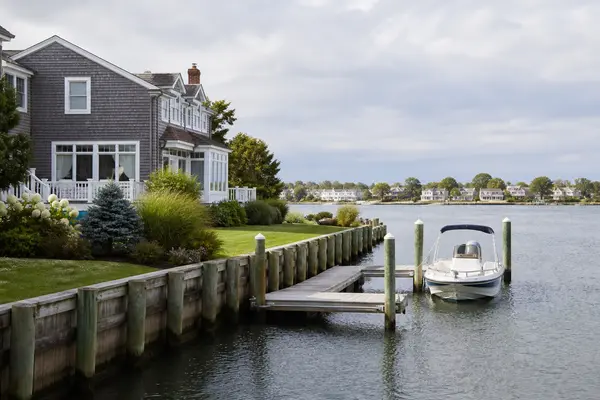
A standard home inspection is important, but waterfront components may require specialists. Ask an experienced marine contractor or engineer to evaluate the bulkhead, tiebacks, cap, pilings, dock framing, electrical service, boat lift, drainage, and visible settlement. Find out who owns each structure and who is responsible for repair.
Request permits and invoices for major work. Confirm whether future repair, replacement, dredging, or enlargement would require municipal, county, state, federal, or association approval. Never assume an existing structure can automatically be replaced in the same dimensions. Your attorney, surveyor, and the appropriate permitting offices should verify the rights and restrictions tied to the parcel.
Inspect the house for coastal exposure
Salt air, wind-driven rain, moisture, and seasonal vacancy can affect a home even when it has not experienced a major flood. A careful inspection should address the roof, flashing, siding, windows and doors, crawlspace or lower level, foundation, HVAC equipment, electrical panels, corrosion, drainage, sump systems, mold indicators, and any raised utilities.
Ask how the property is winterized, monitored, and maintained when vacant. For an older or renovated house, compare permits with the current layout. If you plan an addition, pool, new dock, lift, or substantial renovation, investigate feasibility before assuming the project belongs in your budget.
Build an address-specific ownership-cost worksheet
The purchase price is only one part of waterfront ownership. Before you choose a target price, collect real estimates for:
- Property taxes and any current or pending assessments
- Homeowners, flood, wind, umbrella, and boat-related coverage as applicable
- Water, sewer, electric, gas, internet, and seasonal service
- Dock, lift, bulkhead, drainage, and exterior maintenance
- Association, marina, or slip charges when relevant
- Landscaping, winterization, security, and vacancy monitoring
- A reserve for larger coastal repairs and insurance deductibles
Verify the assessment and tax record with the Point Pleasant Borough Tax Assessor. Taxes should be checked for the individual parcel; a prior owner’s bill or deduction may not predict yours. For broader context, review the established Point Pleasant market update, while treating any fast-changing market data as a snapshot rather than a guarantee.
How to compare two waterfront homes fairly
Create the same one-page scorecard for every property. Include usable living space, condition, flood-zone and elevation information, insurance quote, bulkhead and dock condition, water depth, bridge clearance, navigation route, parking, permit history, and your estimated five-year maintenance reserve. This helps prevent a renovated kitchen or wide view from hiding a costly shoreline obligation.
Use conservative assumptions when a document or quote is missing. Your offer can reflect verified condition, and appropriate inspection or attorney-review protections can give your professionals time to confirm the details. Search current homes across the Shore and learn more about Kyle’s local approach before narrowing the list.
Frequently asked questions
Is every waterfront home in Point Pleasant in the same flood zone?
No. Flood-zone designations and elevations are parcel-specific. Check the exact address through FEMA and confirm the current information with the municipality, your lender, and an insurance professional.
Does a private dock automatically transfer with the house?
Not always. Ownership, permits, riparian rights, leases, association rules, and use restrictions should be reviewed through the survey, title work, municipal records, and legal counsel.
Can I rely on the seller’s flood-insurance premium?
No. It is useful background, but your premium and coverage may differ. Get a quote based on your intended occupancy, coverage choices, lender requirements, and the property’s documents.
What extra inspections should a waterfront buyer consider?
In addition to a full home inspection, consider qualified review of the bulkhead, dock, lift, pilings, drainage, elevation documentation, lower-level construction, and permit history.
Is Point Pleasant the same as Point Pleasant Beach?
No. They are separate municipalities. Always confirm the municipal address because local rules, services, taxes, and permit offices differ.
Get a custom Point Pleasant waterfront list
Call or text Kyle Pelech at 732-996-7872 and tell me your price range, boat requirements, and intended use. I’ll send the best current Point Pleasant options and help you build an address-specific due-diligence checklist. You can also contact Kyle here.
Categories
Recent Posts





Featured Listings
Representing a Bespoke Collection of Austin’s Finest Properties.


REVIEWS